
Jhotpot — E-commerce Suite
A store platform designed for how Bangladesh actually shops: cash-on-delivery treated as a first-class citizen with fake-order defenses, bKash and Nagad prepay incentives that save real money, courier integrations with COD settlement reconciliation, and a campaign engine that plans Eid sales like software instead of prayers. Flagship blueprint: production-grade and deployable — the Shopify subscription ends here.
The product itself, on every device
studio renders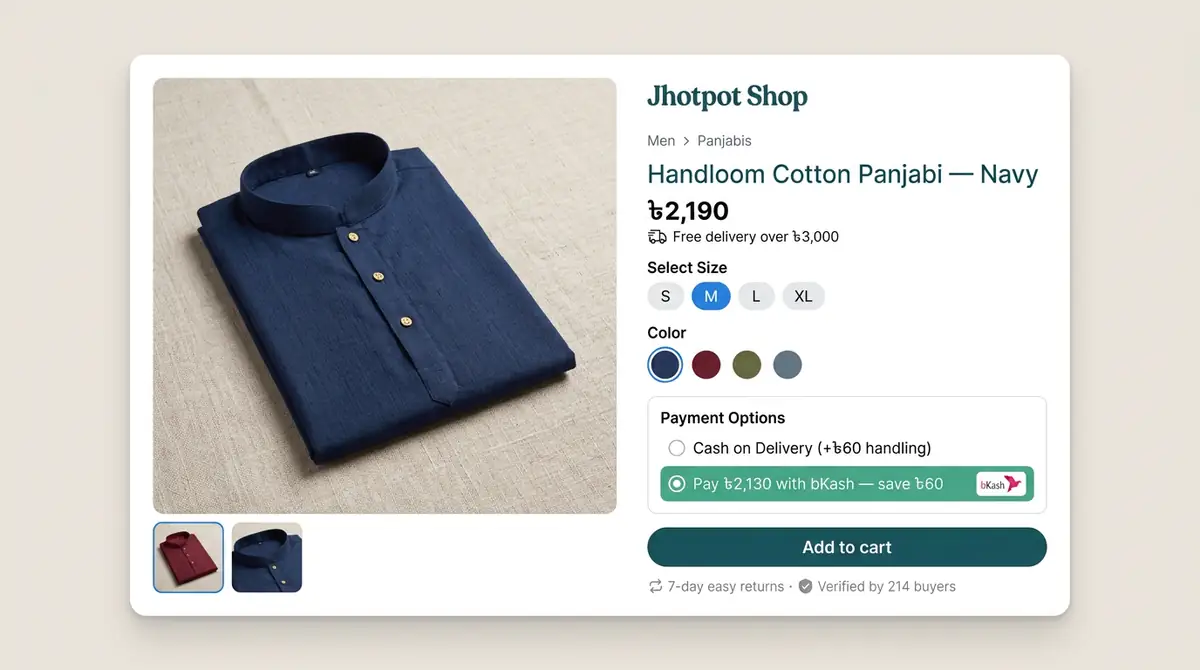
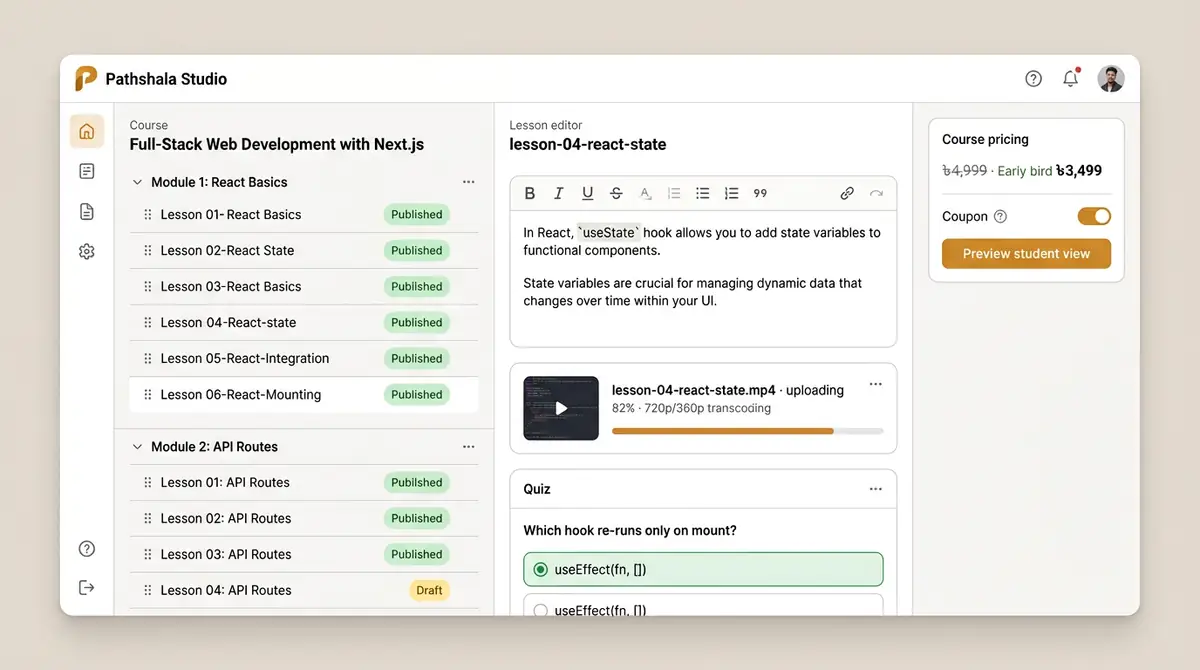
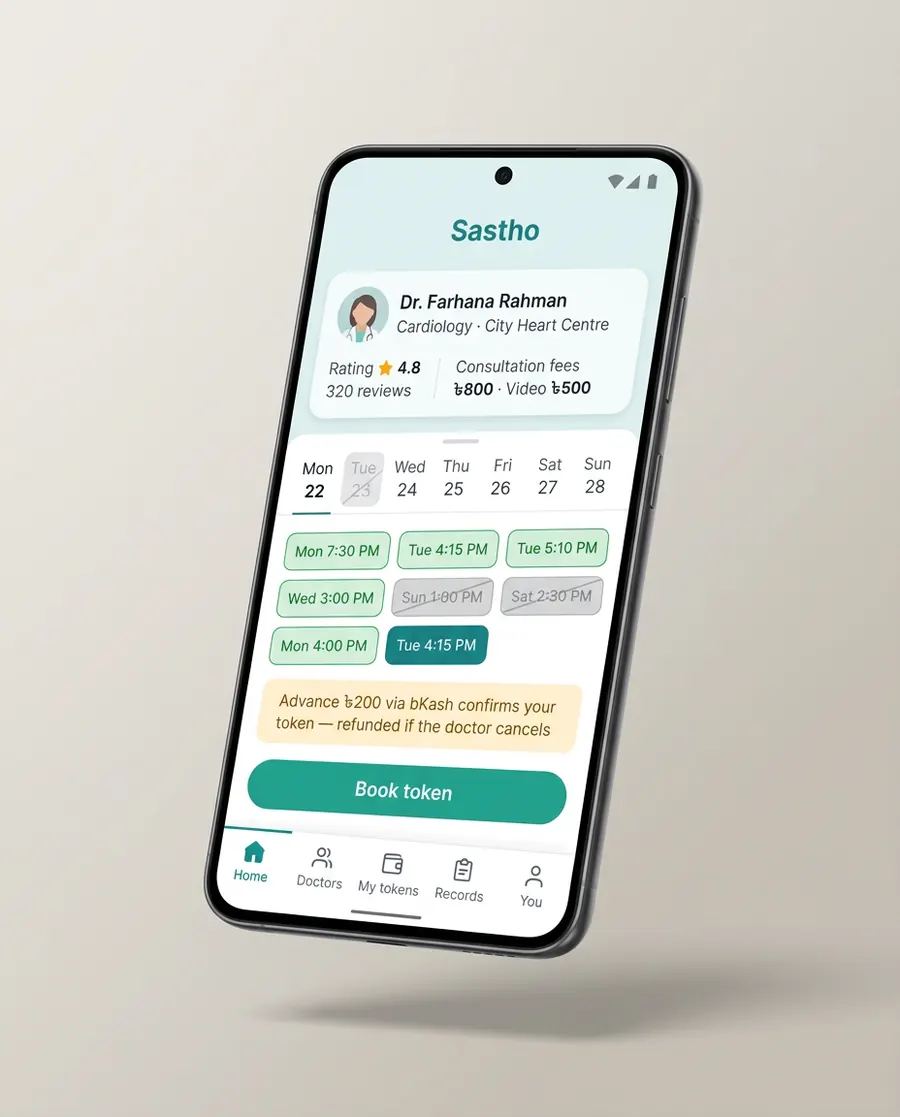
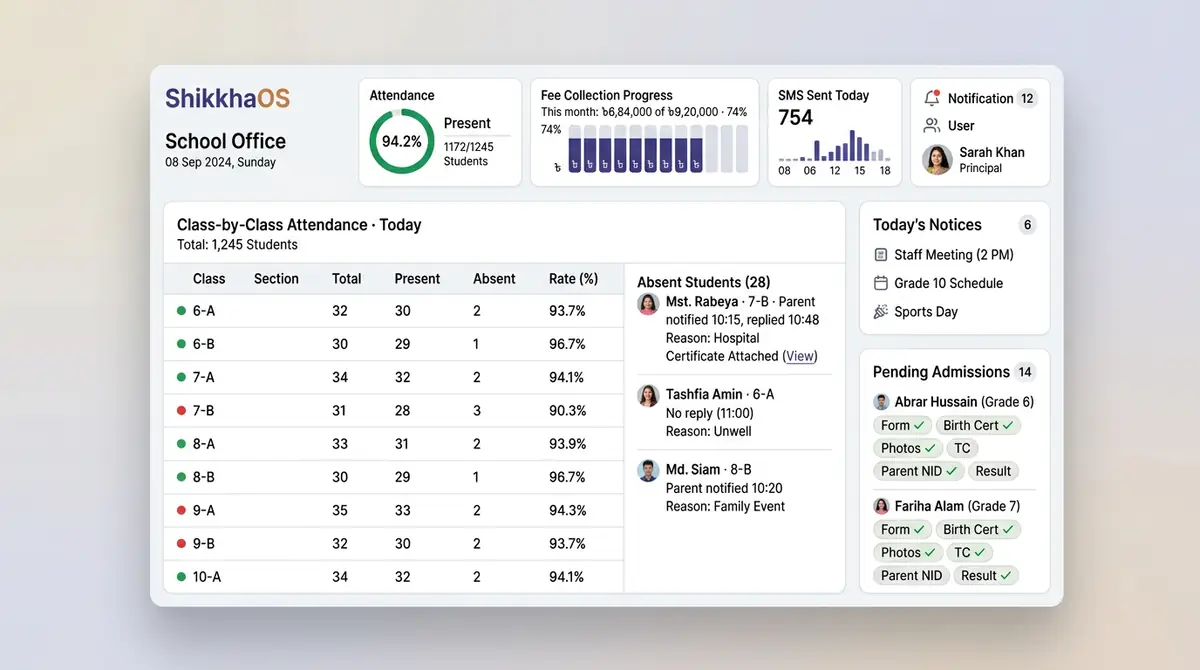
Frames of the live product rendered in the studio pipeline — the site itself is the demo: open anything, it is this codebase running.
The build
Bangladeshi online shopping has a shape the global SaaS builders never modeled: most orders are cash on delivery, most couriers remit that cash on their own schedule, and a real slice of orders simply never receive anyone. A store platform that ignores this is a demo; one that embraces it is a business tool. Jhotpot was built from that truth: COD as a first-class flow with a handling fee and a confirmation call to blunt fake orders, prepay that actually saves the customer money, courier integrations that reconcile every taka remitted against every order expected, and a seller experience that runs from a phone between prayers. It sells this studio's own merch today; a merchant store on it is a configuration, not a rewrite.
What we handled
- COD-first: handling fees, confirmation-call prompts, per-buyer fake-order risk history on the order card
- Prepay incentives wired to bKash/Nagad/SSLCommerz — discount math closes on product page, checkout and ledger
- Courier integrations: pickup booking, labels, tracking sync, and a COD settlement ledger that finds the mismatch
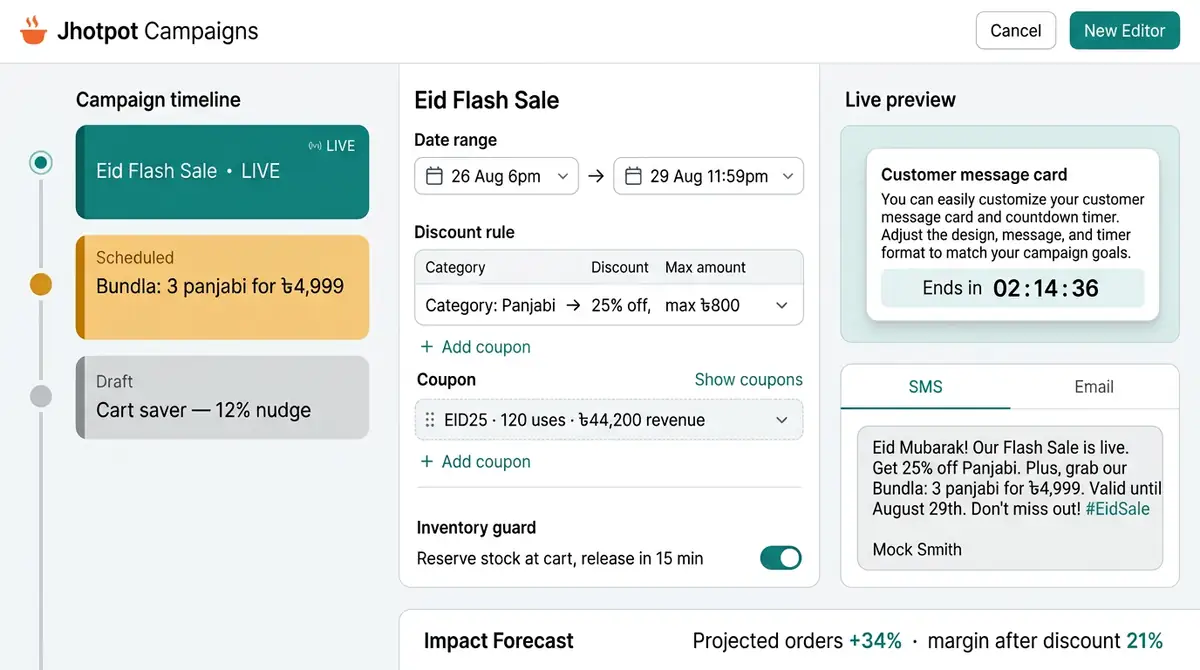
- Campaign engine: flash sales, bundles, coupon ledgers, cart-reserved inventory and SMS/email nudges with countdowns
- Seller phone app: new-order pushes with accept timers, one-tap print-and-pack, stock edits in the queue
- Merchant-owned everything: own domain, own customer list, documented exports, no platform commission on sales
The fifth flagship blueprint, aimed squarely at the country's biggest missed software product: the ordinary Bangladeshi online shop. Jhotpot is a complete commerce suite — storefront, seller phone, courier plumbing, COD money reconciliation, campaign engine — designed around three facts the foreign platforms politely ignore: most orders arrive as cash on delivery, most sellers run from a phone, and most money leaks between courier remittance statements. It runs this studio's own store; your version is the same machine with your brand on it, and it exists partly as a statement: the era of paying Shopify's dollar subscription to sell punjabis in Mirpur should end.
Platforms are designed for the country's habits, not the customer's credit card
Strip global e-commerce lore of its optimism and the local reality is boringly specific: a customer adds three items, chooses COD because trust is earned at the doorstep, the seller calls to confirm because roughly one in five such orders is imaginary, the courier delivers, collects cash, and remits it whenever the courier feels like. Somewhere in that chain — a lost parcel here, an unrecorded remittance there — the shop's margin dies quietly. Every hosted platform we evaluated treated COD as a checkbox on a settings page. For a Bangladeshi merchant it is the whole business.
So Jhotpot was scoped in reverse: design for the COD path first, make the exceptions (fake orders, remittance gaps, doorstep refusals) first-class states in the software, then bolt on the parts everyone demos anyway — storefront polish, campaigns, analytics. That inversion is the entire product thesis, and it is why the suite can be offered as a Shopify alternative rather than another Shopify.
A store that closes, not just displays
The product page ends in a money decision, so the payment block gets the hero position: COD with its honest handling fee next to a bKash option that saves exactly that fee — the same ৳60 the merchant would spend on a phone call and a courier return. It is a pricing lever, not a payment dropdown, and merchants tune it themselves: discount percentage, flat saving, or free delivery over a threshold.
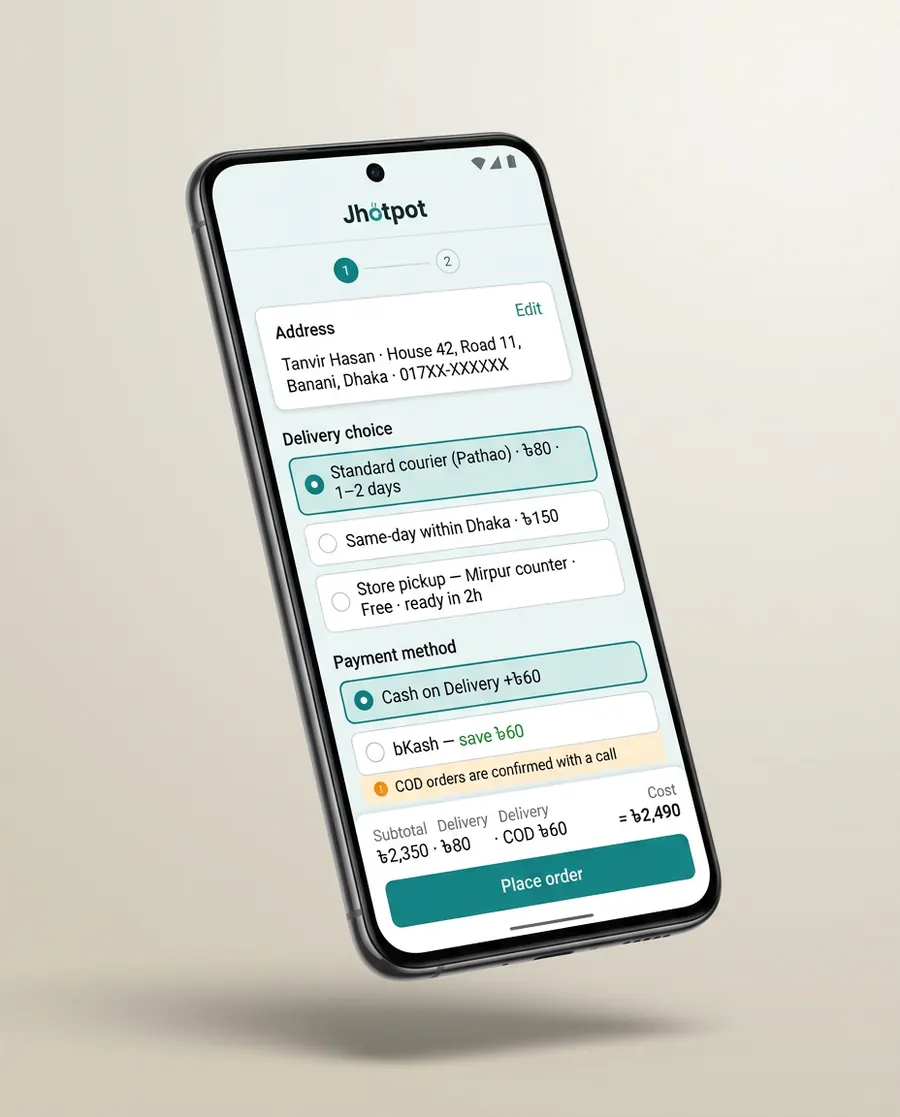
The checkout keeps its arithmetic perfect — subtotal, delivery per selected courier, COD fee, total — and states the confirmation-call policy in one amber line, because customers behave better when the rules are visible. Catalog needs are covered with the unglamorous basics that decide store speed: variant matrices that map to real stock counts, bulk CSV import for shops that already keep an Excel, and Bangla content that renders correctly at every size instead of the tofu boxes a foreign theme drops on them.
The seller's office is a pocket
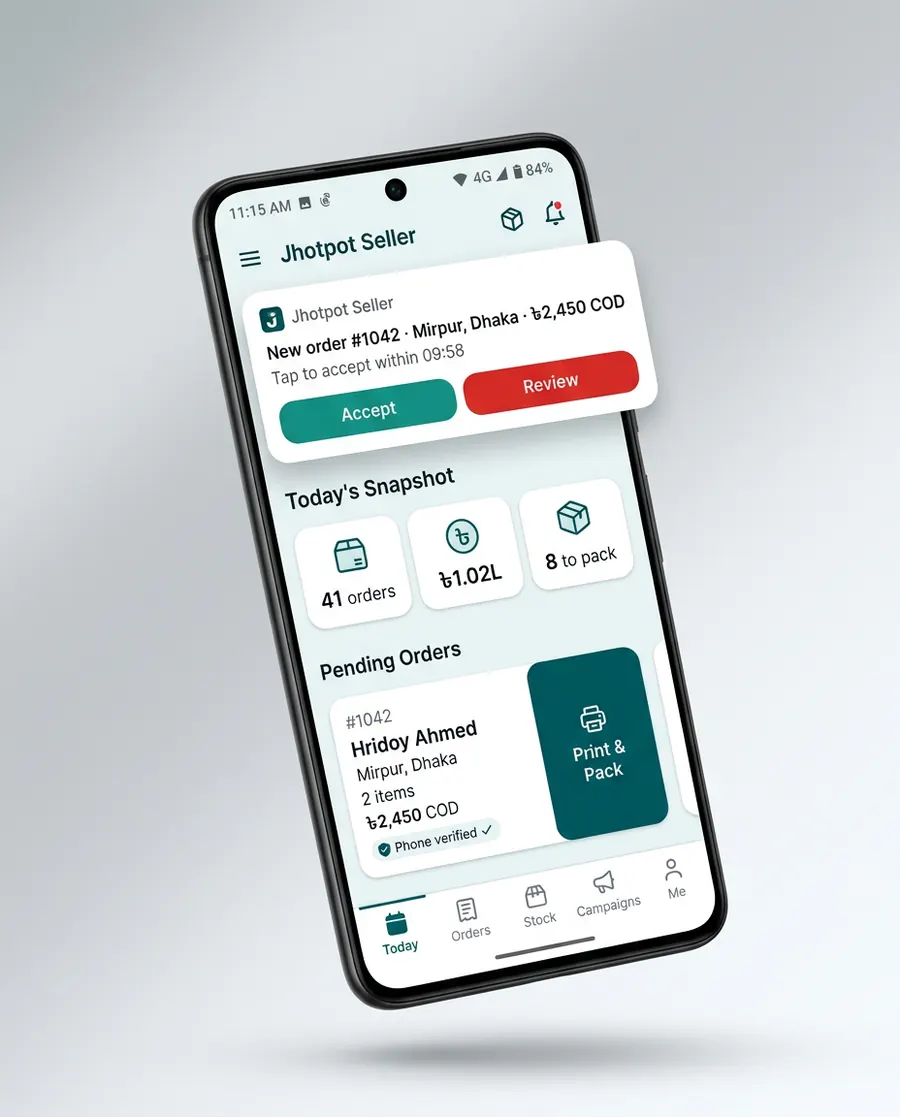
Merchants do not live in admin panels; they live in WhatsApp, and Jhotpot meets them there. A new order arrives as a push with an accept timer, the buyer's verification status on the card face, and a print-and-pack button that produces the courier label before the customer changes their mind. Stock edits, price nudges and campaign starts all run from the same phone — the desktop admin has every feature, not because anyone wants more clicks, but because the accountant needs the ledger.
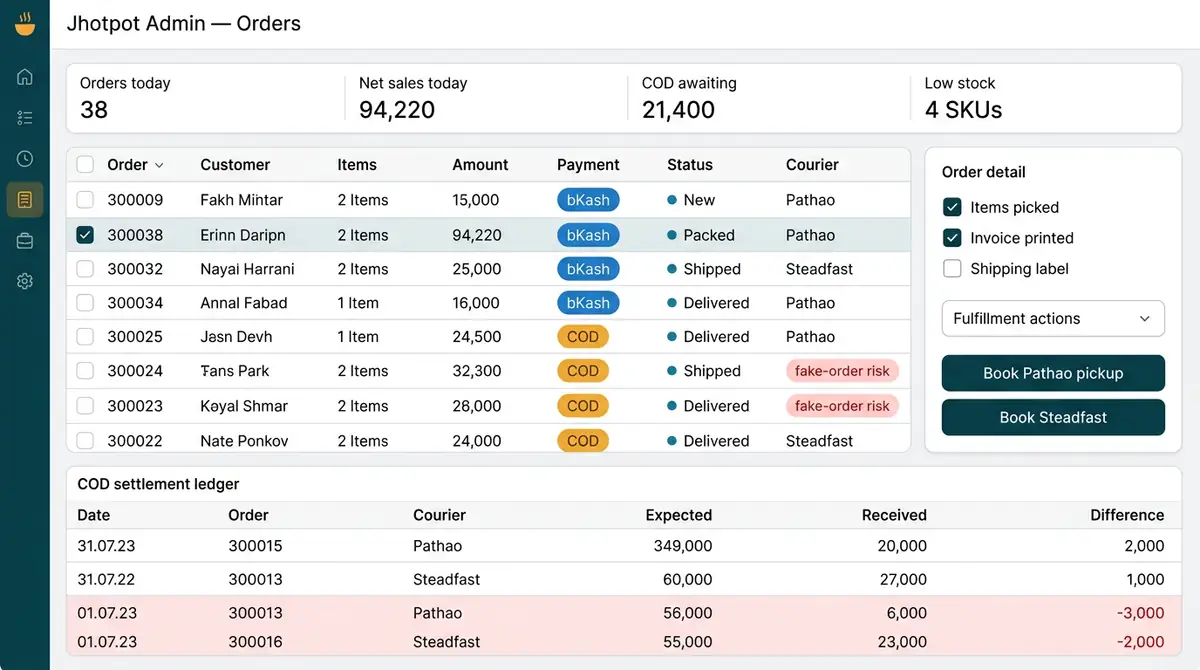
The fake-order machinery hides in plain sight: repeat rejectors accumulate a risk chip on the order card, COD is gated behind confirmation-call prompts above a basket threshold, and a merchant can require bKash advance on the sketchiest categories. None of this needs a fraud vendor or a data-sharing agreement — it is the shop's own history, counted.
Reconciling the courier, every single day
The signature screen is the COD settlement ledger: what couriers should have remitted versus what actually arrived, per order, mismatches tinted red, exports ready for the accountant's argument. It is not a sexy feature and it is the reason shops stay on the platform — money leaks stop when a system counts them daily. Delivery booking, label printing and tracking sync ride along through the courier integrations, so the fulfillment checklist (picked, invoiced, labeled, booked) is the whole desk ritual, digitized without changing anyone's muscle memory.
Payout-side money works on real rails too: bKash and Nagad merchant payments settle into the shop's own account with SSLCommerz as the card route, refunds follow the same ledger discipline, and none of it transits us. The platform's cut is a flat license — no per-sale commission, ever, because percentage models and merchant success stop agreeing at scale.
Eid-grade campaigns, planned like software
The campaign engine treats a flash sale the way an operations person should: a timeline strip for live and scheduled campaigns, discount rules bound to categories with maximum-amount ceilings, coupon ledgers that show claimed versus redeemed, and the load-bearing toggle nobody else ships — inventory reserved at cart and released on a timer, so a viral post cannot sell the same three units eleven times.
Nudges ship as templates that read like a human wrote them: a cart-saver at 12 percent with a countdown, a bundle invite for the second and third item, a restock SMS the day the size comes in. Every message renders identically in the preview pane and the sent inbox, because marketing software that lies about its own preview is just a gambling site for merchants.
Public record
- Blueprint status
- In-house flagship — full store/admin/campaign stack built and exercised internally; first merchant deployments are the offer, not a past case
- Money rails
- bKash, Nagad and SSLCommerz prepay with discounts; COD with handling fee, confirmation calls and buyer risk scoring
- Delivery
- Pathao, Steadfast, Sundarban-style integrations: booking, labels, tracking, COD remittance reconciliation
- Deploy shape
- Merchant's own domain and brand, 8–12 weeks to a live selling store — flat license, no per-sale commission
Under the hood — what each box took to build
Craft, per feature
COD as a first-class flow
Handling fees, confirmation-call prompts above configurable thresholds, per-buyer fake-order history on the order card — the exception path promoted to the main path, which is what it already was on the ground.
Prepay that pays off
bKash, Nagad and SSLCommerz checkouts with merchant-tuned savings math that reconciles across product page, checkout and settlement — incentive design, not a payment icon.
Courier integrations & the settlement ledger
Pickup booking, labels, tracking sync for the couriers merchants actually use, and a daily COD remittance-vs-expected ledger with exports — the feature that pays for the platform.
Seller phone with accept timers
Push-first order handling with one-tap print-and-pack and queue-side stock edits, on an installable PWA — no store approvals, no desktop dependency, works on the mid-range Android the merchant already bought.
Campaign engine with cart-reserved stock
Timed flash sales, category-bound discount ceilings, coupon ledgers and inventory reservations that release on timer — the difference between a sale and a stampede depends on this file.
Catalog done right in Bangla
Variant matrices wired to stock counts, bulk CSV import for Excel-run shops, and Bangla-first rendering across theme and admin — because tofu boxes in a product description are a checkout killer, not a font issue.
Commissioning this shape of product
The plan, as we would propose it
Shop anatomyWk 1–2
Catalog reality (variants, stock truth, price logic), COD and courier account setup, the fake-order policy the merchant actually wants enforced. Output: a signed-off order-state machine, because every later week defends it.
Storefront + checkoutWk 3–5
Branded storefront with Bangla-first content, payment blocks with live savings math, checkout whose arithmetic closes on every device — launched to a soft beta of the merchant's regular customers.
Fulfillment + moneyWk 5–8
Admin, seller app, courier booking and the COD ledger wired to real remittance cycles for two weeks before public launch — the ledger must be boring at launch, which means it gets rehearsed first.
Campaigns + handoverWk 8–12
One planned promo run end-to-end as training, inventory reservation proven under burst traffic, operations docs in Bangla and English, exports verified with the merchant's accountant in the room.
What a client actually wins
Fake-order losses shrink by rule, not by mood
Confirmation prompts, advance-required thresholds and buyer history act on every risky order identically — no more the owner's gut deciding who gets a call, which is how losses used to be sampled instead of prevented.
Courier money stops evaporating
Daily COD reconciliation means a missing remittance is a red row on Tuesday, not a vague suspicion at the Eid stocktake — the single highest-ROI screen in the suite, in this studio's own ledger as evidence.
The platform bill becomes predictable
Flat license replacing dollar-denominated commissions cuts the two worst taxonomies at once: FX exposure and per-sale take. Selling more costs the merchant exactly nothing more in platform fees.
Campaigns that cannot oversell
Cart-reserved inventory with timed release turns the country's biggest promotion failure mode — the viral post that sells stock twice — into a configuration toggle the merchant can flip at 2 a.m. from their phone.
What is not true (yet)
- Blueprint truth: this is our own store's engine with no merchant case studies yet — first deployments are priced like pilots for exactly that reason, and we will not dress this page in testimonials we have not earned.
- It is a store, not a marketplace: Jhotpot gives one merchant a first-class shop, not a Facebook group a vendor board. Marketplace economics — multi-seller payouts, dispute courts, review fraud — are a different product with a different scar budget.
- Couriers set the pace of the money: labels and tracking sync as far as each courier's API allows, and remittance delays stay visible rather than fixable — the ledger proves what is owed, it cannot compel what is late.
- Fulfilment reality stays human: packing errors, doorstep refusals and returns logistics live in the merchant's warehouse, not in software; Jhotpot makes them measurable and routable, and sells nothing more than that.
Testimonial slot — reserved, not invented
The listing has no review wall to quote yet — so there is no quote here. Real, credited words move into this card as players leave them.
Sponsored placement — reserved, disclosure first
Placements & partners
This is where a genuinely used tool or partner link would live — hosting, device labs, our travel products. It ships empty and labelled on purpose: when a sponsored link arrives, it arrives wearing this disclosure, never dressed up as editorial.
Answers where they belong
Questions this project answers
Want Jhotpot-class engineering for your idea?
One brief in, the composer arrives with your platforms pre-ticked — Android, iOS, web, admin.
Why not just use Shopify or WooCommerce?
Shopify charges dollars on sales and treats COD as a footnote — the plugin tax that follows rebuilds the same stack badly, with your data as collateral. WooCommerce is free like a leaky boat is free: hosting, security and the COD patchwork all land on someone's desk by week two. Jhotpot inverts the build: the Bangladesh path is the default, the hosting and the ledger are yours, and the bill is flat.
Can my customers still pay cash on delivery?
It is the first-class citizen — COD flows get handling-fee logic, confirmation-call prompts and risk history by default. The whole point is keeping the way your customers already pay while making its failure modes visible and priced.
What do the courier integrations actually do?
Pickup booking, label generation, tracking-status sync and COD remittance reconciliation against the ledger — for the couriers your area actually serves. Where a courier's API is thin, an export-and-batch flow fills the gap honestly, and the ledger still counts every taka.
Whose data is it when things go wrong with us?
Yours, in documented formats: the catalog, orders, customers and the money ledger export from day one, on your database server or ours with takeout rights in writing. A flat license with open exports is our answer to platforms that monetize the lock-in.
How does inventory survive my next viral TikTok?
Cart-reserved stock with a release timer — units are held only while the checkout session lives, so overselling needs a deliberate toggle flip. One campaign per deployment is rehearsed under burst traffic before launch, which is how the toggle earns its place on the settings page.
How long until my store sells something?
Eight to twelve weeks to a live selling store for a typical catalog of a few hundred products with real courier accounts wired. The soft-beta week against your own regular customers is non-negotiable — it is the part that makes the launch boring, which is the goal.
Begin the ascent
Everything on this page is checkable.
Store listing, code craft, and the way we scope — click through and verify, then send us the brief.