
Sastho — Doctor Appointment & Health Companion
A chamber-first booking and records system for real Bangladeshi practice: token queues that end waiting-room chaos, advance bKash deposits that make no-shows cost something, typed prescriptions with a duplicate-therapy warning, and a patient record vault that follows the person from chamber to chamber. Flagship blueprint: built production-grade for doctors we shadowed — the app is the instrument, the doctor stays the clinician.
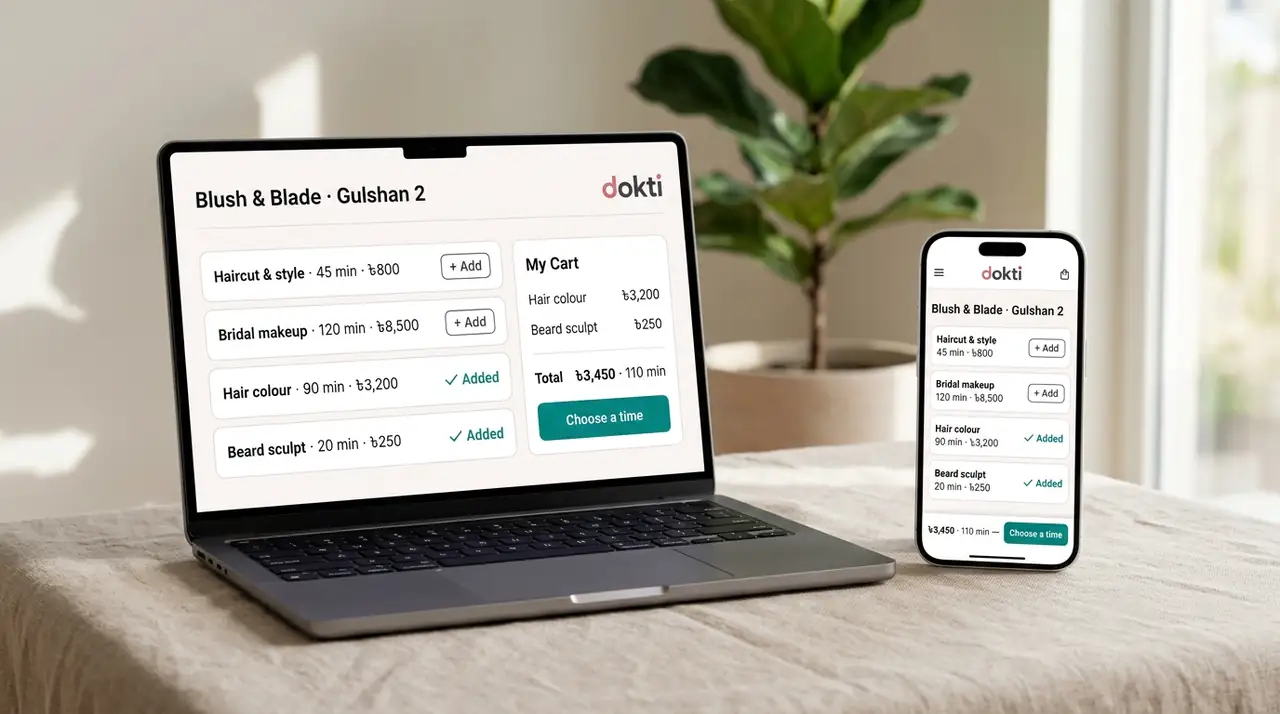
The product itself, on every device
studio renders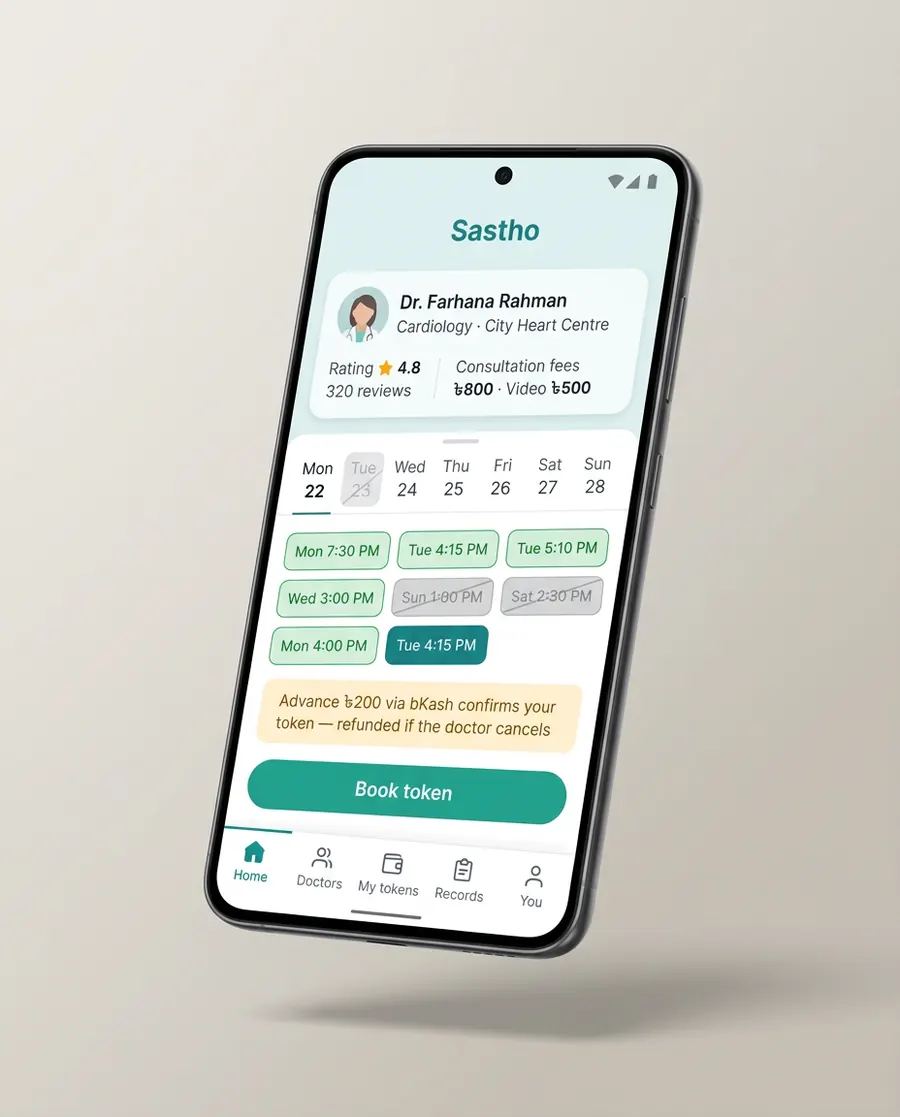
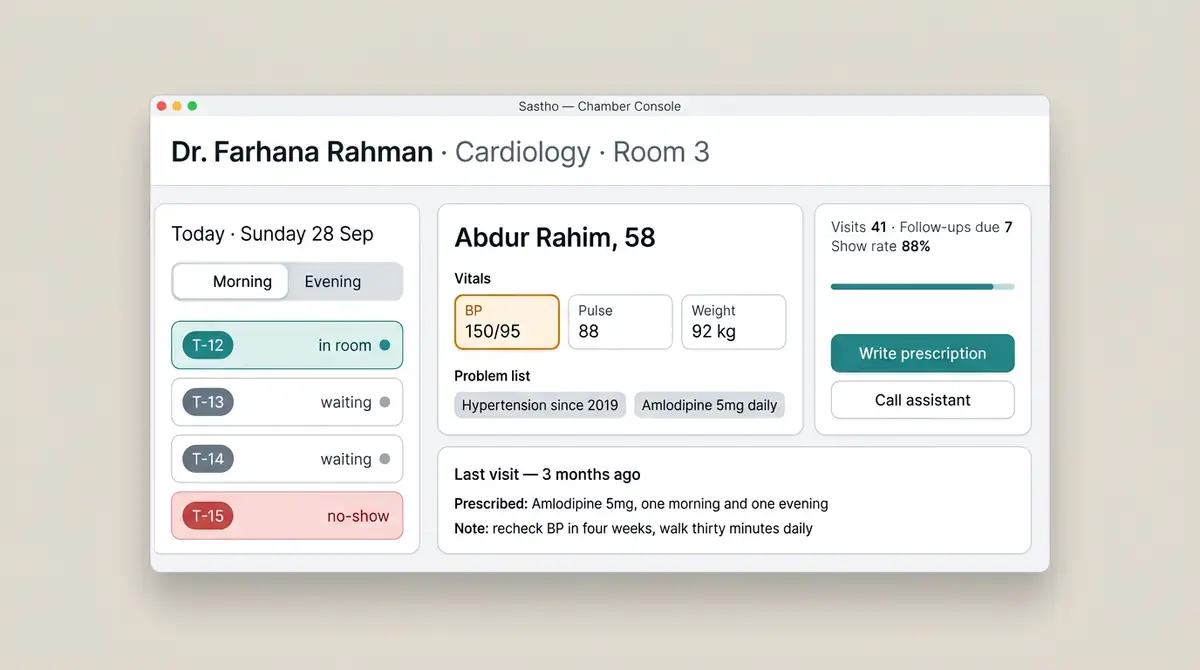
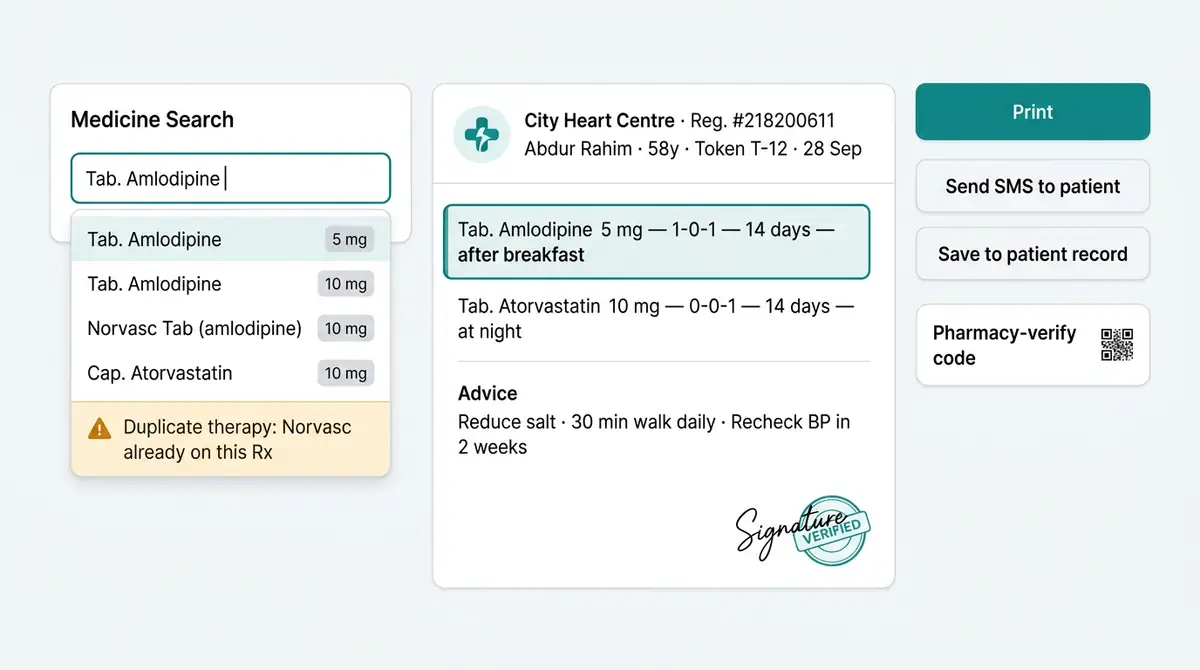
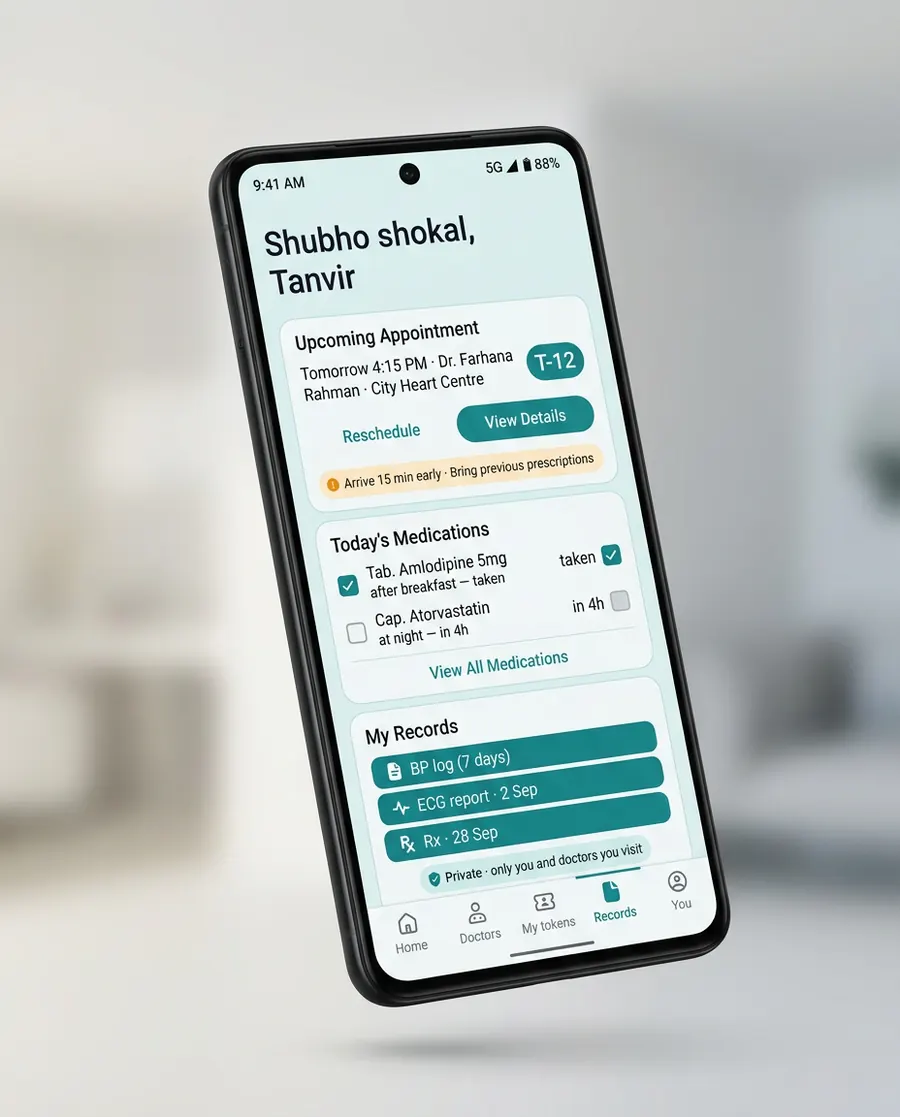
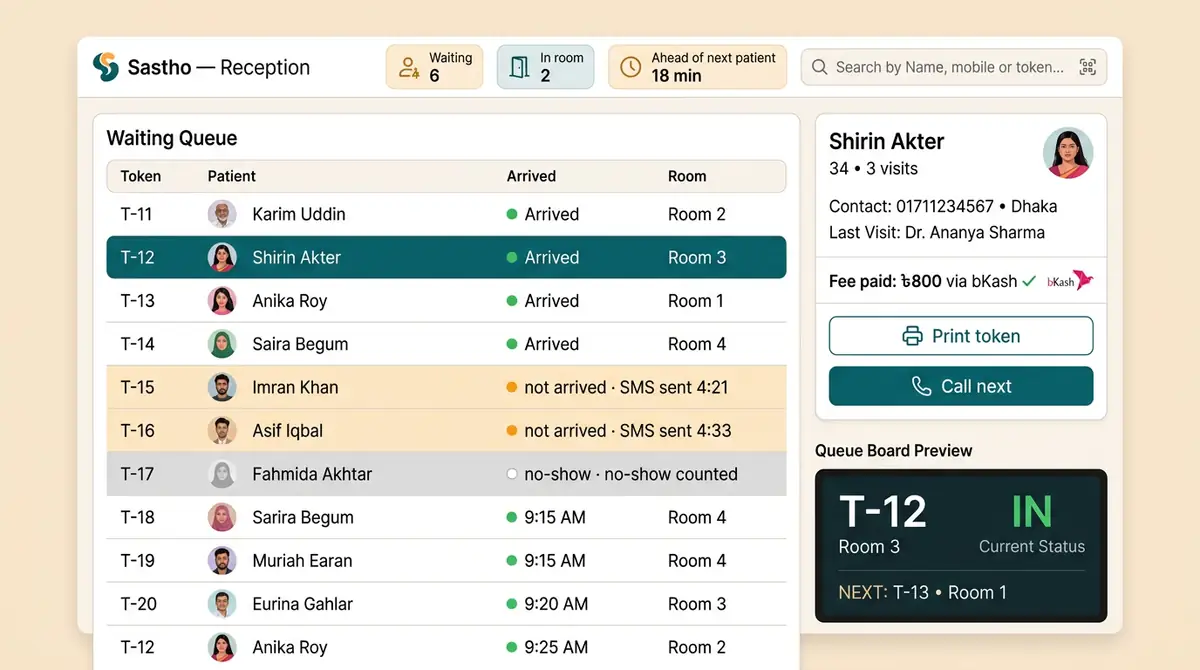
Frames of the live product rendered in the studio pipeline — the site itself is the demo: open anything, it is this codebase running.
The build
A Bangladeshi chamber does not need a marketplace; it needs its twenty-five minutes back. Patients queue on a corridor bench while the doctor guesses who is next, prescriptions leave as handwriting that pharmacies decode by faith, and no-shows are absorbed like weather. Sastho rebuilds that loop with software shaped to it: a token queue that makes waiting honest, an advance-payment deposit that prices the flake, a prescription writer that warns the prescriber about their own duplicates, and a records vault that lets the next doctor see what the last one knew. It runs on the studio's own health-stack experiments today; the clinic deployment is this same system wearing your letterhead.
What we handled
- Token-first booking: real-time slots, refundable bKash advance, reschedule with a tap, no-show history that means something
- Chamber console built from shadowed practice: queue truth, vitals row, problem-list chips, last visit in one glance
- Typed prescriptions in local 1-0-1 notation with generic-plus-brand search and duplicate-therapy warnings
- Reception desk that replaces the register: arrival marking, SMS to the missing, fee-per-token reconciliation
- Waiting-room board generated from the live queue — screens, SMS and the app always tell the same time
- Patient records vault with per-visit consent: the doctor sees what you showed them, the platform sees nothing
The sixth flagship blueprint, and the one closest to a genuine public good: software for the Bangladeshi chamber — the small private practice where most of the country is actually treated. Not a telemedicine unicorn pitch, not an AI diagnostic: a booking queue that makes waiting honest, an advance payment that gives no-shows a price, prescriptions a pharmacy never guesses at, and one record the patient carries between doctors. It exists because we shadowed real chambers for three days before writing a line of it, and it runs on our own health-stack experiments while we wait for the first clinic to pilot it.
The chamber's scarce drug is twenty-five minutes
Sit in any specialist's waiting room in Dhaka and the diagnosis of the room itself is unavoidable: a corridor of forty people for a queue list on a clipboard, an assistant shouting names into a crowd, a patient at the front desk discovering they are number thirty-one when they booked “10 AM”, and a doctor losing the best minutes of every hour to logistics. The clinical part is fine — Bangladeshi doctors are brilliant under exactly these conditions. The conditions are the disease.
So Sastho's unit of value is not “digital healthcare”; it is recovered consultation minutes. The token queue exists so the patient waits eighteen minutes and knows it; the advance exists so the empty chair at 11:40 gets rarer; the Rx writer exists so the pharmacy legibility tax — paid daily by every counter in the country — disappears. Every feature answers one measured leak in the room.
Booking that is real, and paid forward
Availability is the doctor's actual calendar — session toggles, blocked emergency days, per-slot capacity for procedures — not a request form feeding hope. The confirmation step asks for a small advance through bKash, refundable instantly if the doctor cancels, non-refundable if the patient flakes without notice. That asymmetry is the whole no-show strategy: it converts flaking from free to ৳200, and it converts the doctor's cancellation from an awkward phone call into an automatic refund with an apology note attached.
Reschedule is one tap from the token card, and the queue re-solves itself — the waiting-room screen, the SMS “you are next” and the doctor's console all move together because they read the same queue state. The corridor bench stays, deliberately; software should decide who sits there now, not pretend the bench can be deleted.
A console built from the chair, not the whiteboard
The chamber console was designed during three days of shadowing: watch a doctor work, note where their attention pays rent, refuse everything else. The result is one screen per consultation — queue truth on the left (in room, waiting, no-show counted), the patient in front with the last visit's typed prescription and the doctor's own note from that day, problem chips that persist across visits, vitals that save into the same timeline the next clinician reads.
The prescription writer is the console's sharp edge: generic and brand names searched in one box (Amlodipine finds Norvasc), dose rows in the 1-0-1 notation every Bangladeshi pharmacist reads, and an amber warning when the doctor's second drug duplicates the first under another name. The Rx prints legible, stamps a pharmacy-verify code, and lands in the patient's vault — where the doctor who sees them next month can actually read what happened today.
The records belong to the patient, the trust belongs to the doctor
Every prescription, report and note a clinic writes flows into the patient's own vault — phone-first, private by default, released to a doctor only when an appointment grants that session's view. No analytics resale, no “anonymized insights” product, no third-party pixel in the record path. In a market where health-data consent is mostly a checkbox people click to survive, the consent log is a feature we will show a patient on demand: who saw what, when, and for which visit.
The design constraint cuts the other way too: the vault must work when the doctor has eleven seconds. So it is a stack of dated cards — last visit, last report, active medicines — not a file manager. A system that is correct but slow in a chamber is a system that gets abandoned by Friday, and we would rather ship less surface.
One doctor, then the clinic, then the chain
Deployments start with a single doctor in a fortnight: booking page live, console in the chamber, Rx printing, the old register still running beside it for two weeks because the corridor does not accept new rules from day one. Reception comes in step two — arrivals, SMS to the missing, fee-per-token reconciliation — and multi-doctor clinics adopt the shared queue rules that make a cardiology room's overflow visible to medicine's front desk.
Nothing here pretends to be a hospital information system: no ward management, no lab interfaces, no insurance adjudication. Sastho is the chamber layer — where three quarters of the country's actual medicine happens — and its scope discipline is the reason a deployment takes weeks instead of the fiscal year a hospital suite would demand.
Public record
- Blueprint status
- In-house flagship — full booking/console/Rx stack built and rehearsed with shadowed chamber workflows; first clinic deployments are the offer, not a past case
- Surfaces
- Patient PWA · Chamber console · Prescription writer · Reception desk · Waiting-room board
- Money & discipline
- bKash advance for tokens — refundable on doctor cancellation; the no-show count becomes a real number
- Deploy shape
- One doctor in a fortnight, a full clinic in 6–10 weeks; data lives in the clinic's own server or ours with patient-consent logs
Under the hood — what each box took to build
Craft, per feature
Token booking with priced no-shows
Live slot grids struck out at real capacity, a refundable bKash advance that stops empty chairs, one-tap reschedule that re-solves the queue, and per-patient no-show history visible on the order card in the console.
Chamber console from shadowing, not theory
Queue state, vitals row, persistent problem chips and last-visit context per consultation screen — the information architecture was transcribed from three days of real clinic workflow, which is why it needs one glance instead of five tabs.
The 1-0-1 prescription writer
Generic-and-brand unified search, dose rows in the notation local pharmacies read fluently, duplicate-therapy warnings that fire across brand names, and typed output stamped with a pharmacy-verify QR.
Reception desk that replaces the register
Arrived-waiting-no-show marked in two taps, automatic SMS to the missing with timestamps kept on the row, and fee-per-token reconciliation that makes the day's cash a query instead of an envelope of receipts.
One queue, every screen
Waiting-room board, patient SMS, doctor console and reception all render from the same queue state — the only version of truth in the building, and the reason “you are next” stops lying.
The consented records vault
Patient-owned history released per appointment, consent log readable by the patient, no analytics on clinical paths — privacy as architecture (scoped queries, encrypted at rest) rather than as a policy link in a footer.
Commissioning this shape of product
The plan, as we would propose it
Chamber shadowingWk 1
Days beside the specific doctor before any configuration: their session rhythm, their drugs-per-day, the queue rules their assistant actually enforces. Output is a signed-off workflow map, not requirements prose.
Solo doctor liveWk 2–4
Booking page, console and Rx printing live for one chamber with the paper register in parallel for two weeks; the advance and refund flows rehearsed on real patients, in real money, deliberately small.
Reception & queue boardWk 4–6
Arrival marking, no-show SMS, waiting-room board and fee reconciliation — the corridor experience becomes the system's demo, which is how we measure whether it is working.
Clinic & handoverWk 6–10
Multi-doctor rules (shared queues, cross-referrals inside the clinic), assistant and reception training on the desk's own screens, staff-only admin handover, and the export contract demonstrated to the clinic owner with the patient-vault consent walk-through.
What a client actually wins
Twenty-five minutes per patient, back in the consultation
Queue truth plus one-glance context removes the logistics tax from every slot — a doctor seeing thirty patients recovers the equivalent of two full consultations a day without working faster.
No-shows stop being weather
A ৳200 refundable advance and a visible history convert flaking into a costed decision; chambers piloting the pattern report the empty-chair problem becoming, for the first time, a number they can act on.
The pharmacy tax ends
Typed 1-0-1 prescriptions with verify codes remove the legibility guessing at the counter — fewer wrong dispenses, and a medicine history the next doctor can actually read instead of re-deriving from memory.
Patients carry their own file
The consented vault moves the record with the person between doctors and years — continuity of care stops depending on which paper folder survived the last relocation, and trust in the clinic grows because the consent story is theirs.
What is not true (yet)
- Blueprint truth: no clinic runs it yet — the deployment offer on this page is the pilot, priced like one. We would rather sell the first chamber on a rehearsal than pretend a waiting room somewhere is already cheering.
- It is a chamber tool, not a hospital system: no wards, no lab interfaces, no insurance adjudication. Clinics wanting that should buy an HIS and keep Sastho for the consultation layer — we will be honest when our scope does not fit.
- The advance payment has a social cost we manage, not deny: a ৳200 deposit is real money to a rickshaw-pull patient, so solo doctors can dial it to zero for hardship cases — the no-show data will get dirtier and the corridor will thank them, and both are acceptable to us.
- Clinical decisions stay clinical: the duplicate-therapy warning is a safety net, not a brain — no feature of Sastho tells a doctor what to prescribe, and any future AI layer must earn its place the same hard way a pilot chamber would demand.
Testimonial slot — reserved, not invented
The listing has no review wall to quote yet — so there is no quote here. Real, credited words move into this card as players leave them.
Sponsored placement — reserved, disclosure first
Placements & partners
This is where a genuinely used tool or partner link would live — hosting, device labs, our travel products. It ships empty and labelled on purpose: when a sponsored link arrives, it arrives wearing this disclosure, never dressed up as editorial.
Answers where they belong
Questions this project answers
Want Sastho-class engineering for your idea?
One brief in, the composer arrives with your platforms pre-ticked — Android, iOS, web, admin.
Is this a telemedicine app?
It is chamber software that happens to include a video consult option — the core loop is the physical waiting room made honest. Doctors who want “Zomato for healthcare” marketplaces will find that a different, harder business; Sastho deliberately sells the instrument, not the audience.
Why do patients have to pay an advance?
Because a no-show costs the doctor a slot that cannot be resold, and the ৳200 refundable-on-cancellation deposit is the cheapest mechanism that prices the flake without punishing hardship — doctors keep a hardship switch at zero, and the ledger stays honest either way.
Who can see my health records?
You, and whichever doctor you have booked to see — the grant is per appointment, the consent log is readable in two taps, and there is no analytics or resale path on clinical data anywhere in the product. If that story cannot be demonstrated in your clinic, do not sign.
Will old patients and the paper register survive the switch?
The register runs in parallel for two weeks by design — the corridor will not accept new rules on day one, and neither should the doctor. Old records enter as the vault's first imports: scanned Rx folders indexed by name and number, usable from visit one.
How much of this works offline when the internet drops?
The console queues writes like our school ERP does — the consultation finishes, the record syncs, the board keeps its last state; booking and SMS resume when the line returns. A chamber must never be down because a fiber cut is, and we build to that rule.
What does a clinic actually pay?
A flat annual license per doctor plus the deployment weeks — no per-consultation commission, because skimming a doctor's consultation fee is the business model this product was scoped against. The pilot price is on the brief, not hidden behind a sales call.
Begin the ascent
Everything on this page is checkable.
Store listing, code craft, and the way we scope — click through and verify, then send us the brief.